Teddy Riner, a French Judo Icon, Enters the 2027 Presidential Race Against Steep Institutional Odds
Entering France’s 2027 presidential race in early November 2026, five-time Olympic judo champion Teddy Riner tests broad personal popularity against the Fifth Republic’s strict constitutional ballot hurdles and campaign-finance limits. Across 96 surveyed global outlets in seven languages, including 10 analyzed front pages, international coverage weighs his steep political gamble.
Convergent Factual Baseline
- On Monday, November 9, 2026, Teddy Riner (37) launched his non-partisan 2027 presidential bid via social media video and an interview in Le Parisien under the participatory banner “La France qu’on veut,” backed by former Health Minister François Braun while keeping Los Angeles 2028 open.
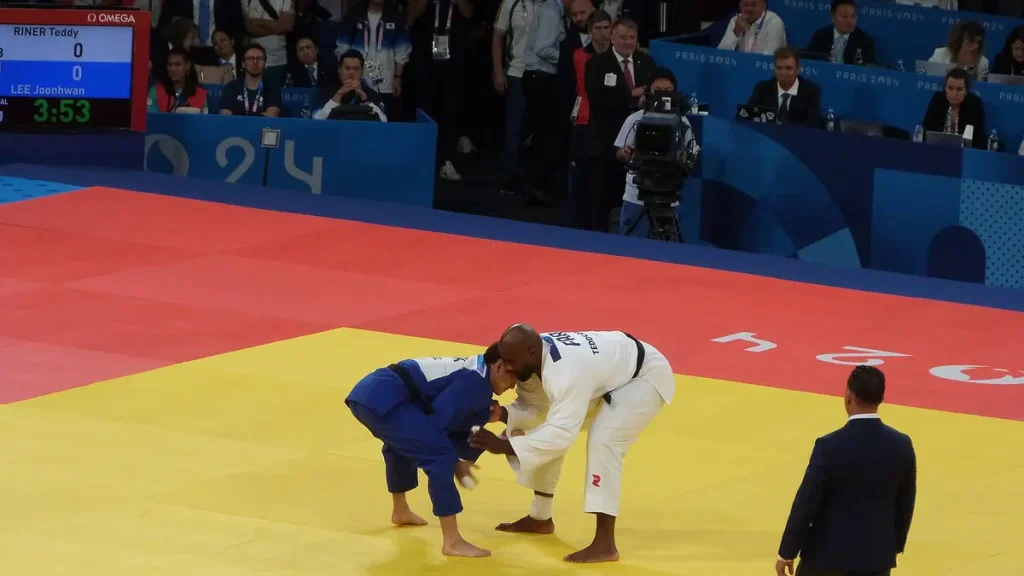
- His career record comprises 5 Olympic gold medals (3 individual +100 kg titles in 2012, 2016, and 2024 plus 2 mixed-team golds in 2021 and 2024, alongside 2 bronzes) and 11 individual world titles (9 at +100 kg and 2 Openweight titles in 2008 and 2017, plus 1 men’s team world gold in 2011).
- On Tuesday, November 10, 2026, an Ifop-Fiducial poll for LCI and Sud Radio recorded a 70% favorable rating versus 22% electoral potential (4% certain, 18% possible), while a Cluster17 first-round poll for Politico across 18 contenders (cited by Le Dauphiné Libéré) placed him at 2%.
- Ballot qualification before the Constitutional Council requires 500 public sponsorships from roughly 42,000 eligible elected officials across at least 30 departments or overseas collectivities (maximum 50 per department) and compliance with Electoral Code Articles L. 52-8 and L. 52-1.
High Personal Popularity Does Not Easily Translate Into Votes
Launching his campaign through a social-media video and an interview in Le Parisien, the Guadeloupe-born champion caught French political parties off guard five months before the April 18, 2027 first round, with sponsorship filings closing on March 12. Former Health Minister François Braun anchors health and social proposals, while Philippe Véran chairs the campaign funding association and Cédric Viot leads the 500-sponsorship drive. Riner targets the gap between gross and take-home pay alongside schools and hospitals while preserving plans for the 2028 Los Angeles Olympics. The Guardian and Time questioned that dual schedule at once.
Polling published on Tuesday, November 10 by Ifop-Fiducial for LCI and Sud Radio showed a 48-point chasm between civic warmth and ballot intent. As Le Monde and Reuters observed after President Emmanuel Macron saluted the “great champion,” Riner’s entry crowds center-right primary arithmetic without building any local party structure. Celebrity rarely builds a party machine.
Mayoral Endorsements, Campaign Spending Limits and Airtime Rules Test Independent Outsiders
Across European desks, which account for 39% of tracked coverage via outlets including Switzerland’s Blick, France 24, and Libération, analysts stress how France’s Fifth Republic filters solo runs. Under Law No. 62-1292 of November 6, 1962 and Organic Law No. 76-528 of June 18, 1976, contenders need 500 signed sponsorships from roughly 42,000 eligible mayors, lawmakers, and councilors across at least thirty departments, capped at fifty per territory. Independent outsiders face steep ballot thresholds.
Public transparency raises the hurdle on Cédric Viot’s team since Organic Law No. 2016-506 of April 25, 2016 publishes every sponsor’s full name upon receipt. Martinique Socialist lawmaker Béatrice Bellay promised her sponsorship while noting clear differences on economic policy. Conversely, Gruissan mayor and former France rugby international Didier Codorniou publicly declined: “Politics is not a sports competition,” Codorniou said. Signed pledges look scarce outside Paris.
Electoral finance rules create an equally sharp test. Article L. 52-8 of the French Electoral Code bans corporate gifts, loans, and in-kind support and caps personal donations at €4,600 under campaign watchdog CNCCFP. Article L. 52-1 prohibits commercial ads for electoral purposes over the final six months from October 2026, while Arcom monitors broadcast time. Saxo Bank suspended Riner from its marketing campaign on November 12; existing deals (Carrefour, Keepcool and Neoness, Bion 3, Audemars Piguet, and KoRo) remain legal at market rates outside electioneering, yet draw Arcom airtime accounting and reputational scrutiny.
Public reimbursement rules tighten that financial squeeze. Within first-round limits of €16.851 million, candidates face €22.509 million in round two. At 5% or below of valid votes, the French State reimburses 4.75% of the spending cap, up to €800,423 within actual paid outlays. Above 5%, State reimbursement rises to 47.5% of that cap, an asymmetry that chills bank loans.
From Judo’s Birthplace in Japan to Brazil, Past Athlete Politicians Offer Mixed Lessons
Outside Europe, our seven-language audit across 96 global outlets and 10 analyzed front pages records sharper regional contrasts. In Japan, The Asahi Shimbun (朝日新聞) welcomed the sense of civic responsibility invoked by the three-time individual heavyweight (+100 kg) gold medalist. In Seoul and Singapore, The Chosun Ilbo and The Straits Times questioned a presidential contender still training for the Los Angeles Games in 2028. Asian desks question his divided focus.
Across Latin America (Exame, InfoMoney, CNN Brasil) as well as the Middle East and Egypt (Al Jazeera, An-Nahar, Sada El-Balad), editors weighed sporting precedents. France 24 and Brazilian dailies contrast executive officeholders George Weah (Liberia, 2018 to 2024) and Cuauhtémoc Blanco (Morelos, 2018 to 2024) with legislative or cabinet careers like Brazil’s Romário and France’s David Douillet. Because high-stakes European security talks over Ukraine test presidential command, foreign correspondents expect Riner’s bid to turn on fiscal and foreign policy credibility. Program specifics remain untested in debate.
Five months before the vote, SansBiais’s analysis of how foreign press and betting markets price France’s 2027 race underscores the same endorsement and spending barriers facing independent contenders.
Side-by-Side Global Perspectives (Analyzed Sample)
Representative selection of front pages analyzed in detail from the full surveyed panel (isolate any region above):
Le Parisien
Présidentielle 2027 : « Je suis candidat pour dire qu’on peut relever la France », Teddy Riner se lance dans la compétition
Factual & economic angle : Exclusive November 9, 2026 launch interview detailing the “La France qu’on veut” platform, François Braun’s advisory role, and wage-focused priorities.
Key phrasing used : civic candidacy, La France qu’on veut, neither right nor left
The Guardian
'I know what it's like to fight': France's most popular sportsman says he's running for president
Factual & economic angle : Contrasts the five-time Olympic champion’s unmatched personal approval ratings with France’s deadlocked parliamentary blocs.
Key phrasing used : most popular sportsman, fragmented parliament, outsider bid
Blick
Judo-Star Teddy Riner will Frankreichs Präsident werden
Factual & economic angle : Examines the institutional leap from Olympic mats to Fifth Republic governance and the 500-sponsorship requirement.
Key phrasing used : Judo-Star, 2027 presidential election, 500 sponsorships
Time
Meet Teddy Riner, the Decorated Olympian Running for French President
Factual & economic angle : Introduces U.S. readers to the Paris 2024 cauldron lighter and his unconventional pledge to keep LA 2028 on the table.
Key phrasing used : decorated Olympian, Paris 2024 cauldron, 2027 presidential race
Variety
French Judo Legend Teddy Riner Announces 2027 Presidential Bid, Drawing Praise From Emmanuel Macron
Factual & economic angle : Tracks Emmanuel Macron’s warm public response and the international media wave triggered by Riner’s video.
Key phrasing used : judo legend, presidential bid, Macron reaction
The Asahi Shimbun (朝日新聞)
柔道王者リネール氏、フランス大統領選への出馬表明 「責任果たす」
Factual & economic angle : In judo’s homeland, covers Riner’s pledge of civic duty (“fulfilling responsibility”) and his historic stature in heavyweight competition.
Key phrasing used : judo king, candidacy announcement, civic responsibility
The Chosun Ilbo (조선일보)
France's Judo Hero Teddy Riner Announces 2027 Presidential Bid
Factual & economic angle : Weighs Riner’s athletic prestige against the challenge of assembling an economic platform without party backing.
Key phrasing used : judo hero, 2027 presidential bid, political newcomer
The Straits Times
Judo king Teddy Riner joins fight for French presidency
Factual & economic angle : Reviews Riner’s Guadeloupean roots and the constitutional and financial filters awaiting independent French contenders.
Key phrasing used : judo king, French presidency, constitutional hurdles
Al Jazeera (الجزيرة)
تيدي رينر.. بطل الجودو الطامح إلى رئاسة فرنسا
Factual & economic angle : Profiles the champion’s political positioning and questions whether personal popularity can translate into grassroots electoral organization.
Key phrasing used : judo champion, French presidency, post-Macron race
Exame
Quem é Teddy Riner, lenda do judô que quer ser presidente da França
Factual & economic angle : Explains Riner’s commercial profile to Brazilian business readers alongside Latin American precedents of athletes entering politics.
Key phrasing used : judo legend, independent candidate, French elections
Full flat index of 96 surveyed outlets (10 front pages analyzed in the comparator)
This flat index lists all 96 deduplicated international outlets that covered this story in our multilingual survey. A representative selection of 10 front pages is analyzed in detail in the continental comparator.